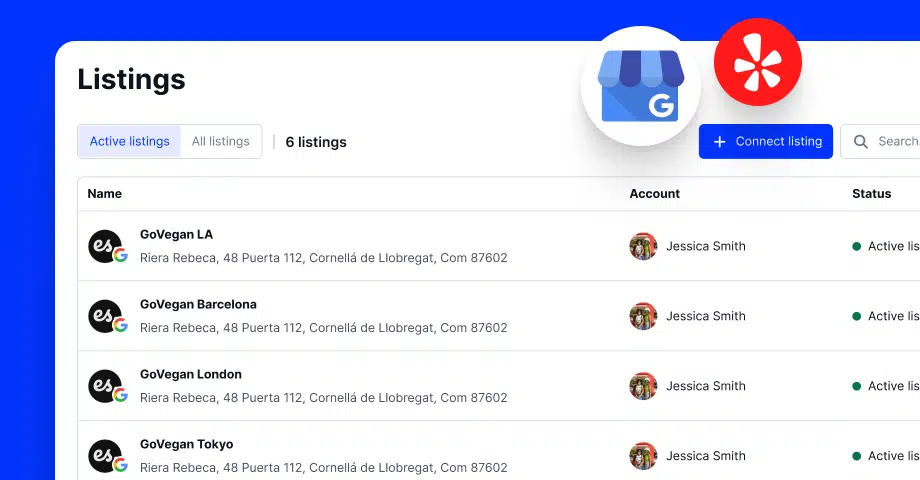
Local citations play a crucial role in boosting your business’s online presence, especially in local search results, which helps you top your competitors.
After all, they showcase your business’s name, address, and phone number (NAP) on the web, thus helping customers find and trust your business.
From appearing in Google’s Local Pack to enhancing your SEO strategy, citations are crucial for your marketing success and sales numbers.
So whether dealing with structured listings on Yelp or unstructured blog post mentions, you must keep them accurate and consistent at all times!
If you are looking to build your online reputation for multiple locations on Google, keep reading below. I’ll tell you all about local citations and how to use them best!
What are local business citations?
Local citations are online mentions of your business’s name, address, and phone number (NAP), and they can appear in a variety of places, including directories, websites, social media platforms, blogs, or news articles. Their purpose is to help potential customers discover your business and provide vital information about where you’re located and how to contact you.
“Local citations” definition
These citations can be broadly categorized into two main types: structured and unstructured, both of which play vital roles in improving local SEO:
Structured citations
Structured citations are organized mentions of your business’s NAP information that follow a consistent format since they are typically found on business directories, review platforms, or location-based services. Here are some examples:
- Google Business Profile – your Google profile displays comprehensive business details, including your NAP, operating hours, and customer reviews;
- Yelp – provides NAP details, plus photos, business categories, and ratings;
- Bing Places for Business – this is a directory similar to Google Business Profile, and it allows your business to appear in Bing’s local search results;
- Industry-specific directories – there are some niche platforms like Zocdoc (for healthcare providers) or Tripadvisor (for hospitality businesses) that offer structured citation opportunities tailored to specific industries.
These citations are especially powerful for local SEO as they provide search engines with clearly formatted, reliable data to validate your business’s legitimacy.
Unstructured citations
On the other hand, unstructured citations are informal mentions of your business’s NAP details that can appear anywhere online. These mentions are often integrated into content and are not part of dedicated business profiles. Some examples include:
- Blog posts – articles that reference your business or link back to your website. For example, a local food blogger writing about your restaurant;
- News articles – coverage of your business in local or national media;
- Social media posts – posts or comments that include your business’s NAP details, such as a Facebook post tagging your business or a tweet with your location;
- Community websites – local event pages, forums, or community boards that reference your business as a sponsor or participant.
Despite not following a standard format, these types of citations still carry weight in local SEO. After all, when they appear on high-authority websites, they strengthen your business’s online reputation and increase its visibility.
Both structured and unstructured citations are essential for your local SEO metrics, structured citations provide reliable data for search engines, while unstructured citations create opportunities for your business to appear online organically.
Why do local business citations matter for businesses?
Local citations are a critical factor influencing your local SEO rankings. Consequently, search engines rely on them to determine the legitimacy, relevance, and prominence of your business in the local search ecosystem. So, let’s break down why they matter:
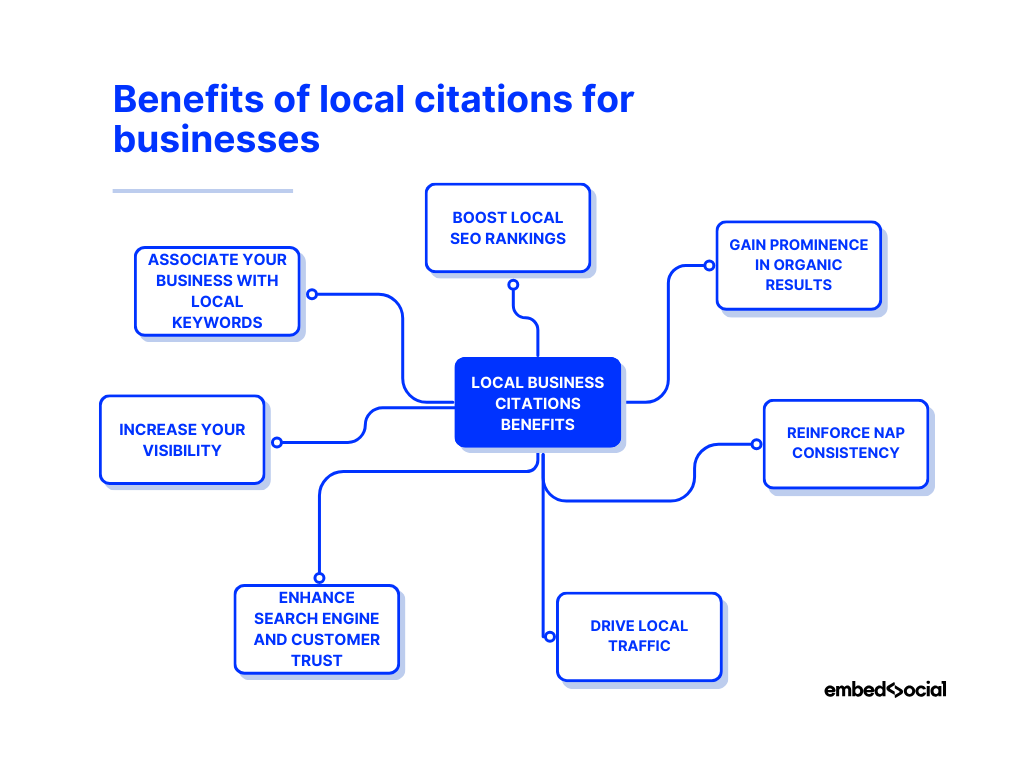
- Boost local SEO rankings – consistent citations across reputable directories and websites signal to search engines that your business is credible and trustworthy, increasing your chances of passing your local SEO audit with flying colors;
- Gain prominence in organic results – even outside of the Local Pack, citations contribute to better visibility in organic local search results by signaling the relevance of your business to location-based queries, such as “best pizza in town”;
- Reinforce NAP consistency – accurate and uniform name, address, and phone number (NAP) information across citations helps search engines verify your business details, making it easier to display your business in search results;
- Drive local traffic – by ensuring your business is mentioned on frequently visited directories and platforms, citations increase the likelihood of customers finding and visiting your business, which is crucial for businesses with physical stores;
- Enhance search engine and customer trust – search engines treat citations as “votes of confidence” for your business, particularly when they come from reputable sources, so having accurate citations shows your business is legitimate;
- Increase your visibility – the more your business appears in reputable directories and websites, the easier it is for potential customers to find you;
- Associate your business with local keywords – citations with optimized descriptions or tags can help your business rank for specific local keywords.
As you can see, citations have the power to increase your Google Business Profile traffic, so maintaining consistent and accurate information across the web will not only enhance your visibility but also give you a competitive edge in local search.
Local citations vs local business listings
At first glance, a local business citation and a local business listing may seem interchangeable, but they are not exactly the same.
Local business listings are detailed profiles of your business created on specific platforms, whereas local citations for SEO are broader mentions of your business. As such, you could say that local business listings are a subset of local citations.
Remember: business listings are structured, comprehensive entries designed to engage customers and provide detailed business insights. On the other hand, citations exist anywhere your business is mentioned.
Furthermore, business listing profiles may also include information like your business hours, customer reviews, photos and videos, services or products offered, and links to your pages.
Conversely, local citations can take the form of unstructured mentions in blogs, news articles, forum discussions, social media posts, and mentions in local event pages.
Here’s a nifty table containing the key differences between both:
Aspect
Local Business Listings
Local Citations
Scope
Structured profiles on specific platforms.
Includes both structured and unstructured mentions.
Purpose
Attract and inform customers with detailed data.
Enhance local SEO signals and credibility.
Details
Includes NAP, reviews, photos, and services.
Primarily limited to NAP information.
How to manage your local citations with EmbedSocial?
Keeping your business information consistent across Apple Maps, Bing, and Yelp can be time-consuming, but now, you can monitor and fix discrepancies in seconds.
EmbedSocial’s new Local Citations tool, which is part of its Google Business Profile management suite, helps you track your business listings across these key platforms and instantly compare them to your official Google details.
This ensures consistency, boosts your local SEO, and saves hours of manual checking.
Here’s how it works.
Step 1: Sign up for EmbedSocial’s GBP platform
Naturally, you first have to create an EmbedSocial account and sign in. You can also start a 7-day free trial to check out the tool.
Step 2: Access the Local Citations section
From your EmbedSocial dashboard, go to ‘SEO management’ area from the left ribbon menu and tap on ‘Local citations’:

Step 3: Review your Google profile baseline
At the top of the screen, you’ll see the baseline info pulled directly from your Google Business Profile, your address, phone number, website, and business hours.
This data acts as the “source of truth” when comparing against third-party platforms.

Step 4: Compare with Apple, Yelp, and Bing
Below the baseline section, you’ll see a three-row table for Yelp, Apple Maps, and Bing Places, showing you whether their details match your Google profile:

Each row checks whether your business is listed and whether the details match. The table shows:
- Status (e.g., Mismatch, Missing, Not Found);
- Address, Hours, and Phone field checks;
- Last update date.
Step 5: Identify and fix mismatches
If your business info is incomplete or mismatched, the tool highlights what’s wrong, so you can easily fix it by visiting these directories:
- Not found: listing doesn’t exist on the platform;
- Mismatch: some info doesn’t match your Google listing;
- Missing: key fields like hours or phone are empty.
At this point, you have to use this overview to update your listings on those platforms manually.
Optional Step: Flag incorrect matches
Sometimes the system may return a similar business that isn’t yours. If that happens, click “Not your business?” and enter your correct business URL. Our team will manually verify and adjust it.
Naturally, this tool is designed for multi-location businesses trying to stay consistent across all major directories. It helps protect your SEO efforts, ensure trust with customers, and eliminate manual citation audits. That said, you still have to do some manual tasks. Read on below.
How to manually build & optimize local citations for your business?
Now that you know what local listing citations are and how they matter for your business, it’s time to learn all there is to learn about local citation building.
Ensuring your citations are accurate, consistent, and comprehensive can significantly enhance your business’s credibility and rankings in local search results.
Here’s how you can get started manually:
1. Find, claim, and verify your business listings
First of all, there might be existing citations of your business that you have not uploaded or corrected. So the first step is to check all major directories and platforms to ensure you have control over the information displayed. Platforms to prioritize include:
- Google Business Profile
- Yelp
- Bing Places for Business
- Apple Maps
You must verify your ownership of all these citations to unlock advanced features and prevent unauthorized changes to your listings.
However, before doing so, it’s crucial to optimize your Google Business Profile. One platform that will help you with that is EmbedSocial, you can update and maintain your business information, respond to reviews, analyze performance, and much more.
Pro tip: if you are managing a multi-location (or multi-brand) business you must create location SEO pages for every single Google Business location.
2. Get listed with all major data aggregators
Once you update your existing information, you should also ensure you are listed with every important data aggregator in the U.S. (or elsewhere).
These companies are very important as they collect your NAP info and distribute it to all kinds of sites and directories. These are the three big ones in the U.S.:
- Express Update
- Neustar Localeze
- Factual
Note: Claiming and maintaining your NAP data with these aggregators is free.
3. Submit your business to niche and local directories
Beyond the major platforms and data aggregators, you should also submit your business details to directories specific to your industry or location. For example:
- Healthcare – Zocdoc, Healthgrades
- Hospitality – TripAdvisor, OpenTable
- Legal services – Avvo, Justia
Pro tip: You should also consider contacting your local Chamber of Commerce and other local business associations, as they can feature your business data too!
4. Ensure NAP consistency across all platforms
Now that you are listed everywhere you need to appear; you must ensure that your information is the same across all these sites, NAP consistency is the backbone of successful local citations. Ensure that your name, address, and phone number (NAP) are:
- Accurate – match your official business name and contact details;
- Consistent – avoid using abbreviations or variations across relevant business directories (e.g., “Street” vs. “St.”);
- Updated – Revise your information promptly if you change details.
Remember: Duplicate listings or outdated information can confuse search engines and harm your local search queries. Therefore, you must use tools or manually audit your citations to identify duplicate listings, update incorrect details, and close outdated accounts.
5. Optimize your citations for local SEO
You can always make your citations more impactful by optimizing them with additional details, such as:
- Business categories and services offered
- Links to your website or social media profiles
- High-quality images or videos of your business
- Descriptions with relevant local keywords
To help you with Local SEO, you can use the SEO audit checklist that will help you to start optimizing for the local SEO ranking signals
6. Get some unstructured citations too
I’ve already told you about unstructured citations above; now it’s time to pursue them, even though they are harder to get, as people care about them.
To build unstructured citations, consider the following strategies:
- Engage with local bloggers and journalists – get featured in local news articles, industry blogs, or interviews;
- Participate in community discussions – join local business forums, Facebook groups, or LinkedIn conversations where your business might get mentioned;
- Sponsor local events or charities – many event websites list sponsors, giving you an authoritative citation;
- Leverage PR and guest posting – writing guest articles or issuing press releases can lead to valuable unstructured mentions.
Unstructured citations might not always include a direct link, but they still help reinforce your business’s authority and relevance in local search results.
7. Use citation management tools
Since managing citations manually can be time-consuming, you should also consider using various local SEO tools that make the process more straightforward:
- EmbedSocial – for collecting reviews while maintaining NAP consistency;
- Moz Local – for finding and fixing inconsistencies across directories;
- BrightLocal – for auditing, building, and managing citations.
8. Track your progress and performance
Finally, you have to keep monitoring your local SEO performance to ensure that your citations are working to boost your rankings. That way, when people search for your business online, they’ll find up-to-date and uniform information wherever they look.
For that purpose, you can use tools like Google Search Console, Google Analytics, or citation-specific analytics provided by management tools.
Local citation management: 7 best practices
Want to make the most out of your local SEO citations? Take a look at these best practices before you try to build local citations for your business:
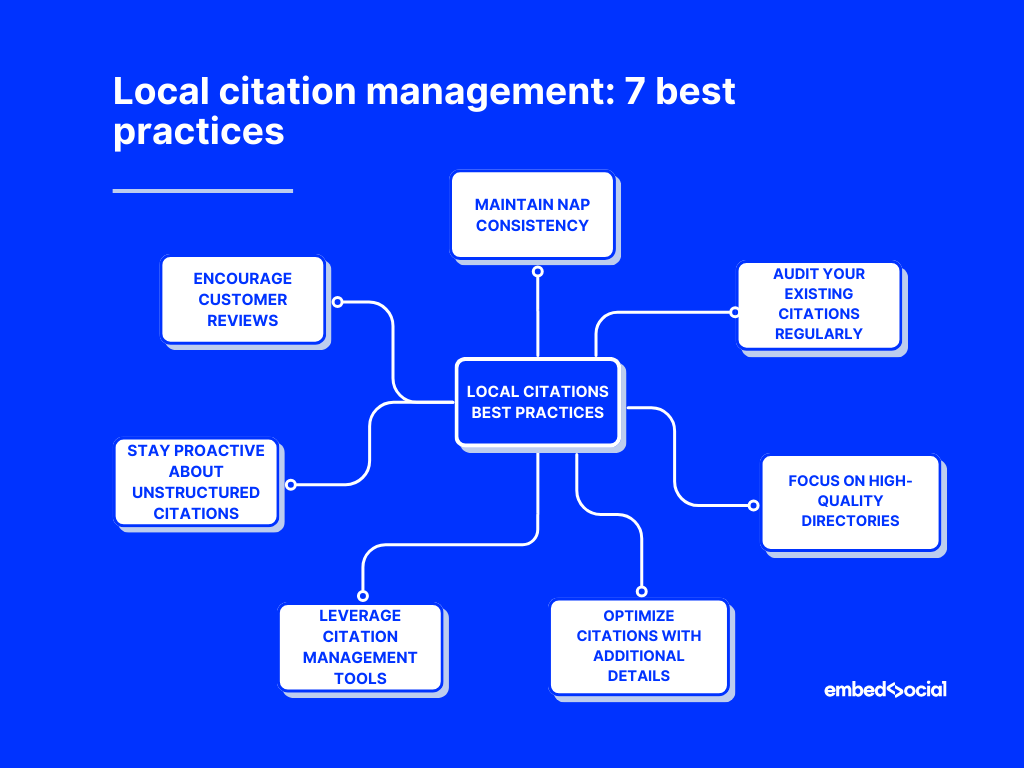
Maintain NAP consistency
Consistency in your name, address, and phone number (NAP) across all citations is non-negotiable. Even minor discrepancies, like abbreviations or outdated phone numbers, can confuse search engines and hurt your rankings:
- Use a standardized format for your NAP information.
- Update citations promptly if your business moves or changes contact details.
Audit your existing citations regularly
Perform regular audits to identify any inaccuracies, duplicates, or outdated information. Tools like Moz Local or BrightLocal can simplify this process:
- Remove duplicate listings to avoid confusion.
- Fix errors in NAP details to maintain search engine trust.
Focus on high-quality directories
Not all directories are created equal. Prioritize reputable and industry-specific platforms for your citations. High-quality directories are more likely to enhance your credibility and local rankings
- Use niche directories relevant to your business category.
- Avoid low-quality or spammy directories that could harm your online reputation.
Optimize citations with additional details
Make your citations stand out by adding more than just your NAP information. Include:
- A detailed business description with local keywords.
- High-quality photos or videos of your location, products, or services.
- Links to your website and social media pages.
Leverage citation management tools
Managing citations manually can be overwhelming, especially for multi-location businesses. Use tools like EmbedSocial, Moz Local, or Whitespark to automate and streamline the process:
- Monitor your citations for accuracy and updates.
- Distribute your information to multiple platforms efficiently.
Stay proactive about unstructured citations
While structured citations are easier to track, unstructured mentions in blogs, social media, or news articles are equally valuable:
- Set up Google Alerts for your business name to monitor new mentions.
- Reach out to bloggers or journalists to correct inaccurate unstructured mentions.
Encourage customer reviews
Many citation platforms, such as Yelp and Google Business Profile, include customer reviews. Positive reviews boost your reputation and strengthen your citations:
- Actively request reviews from satisfied customers.
- Respond to reviews, both positive and negative, to engage with your audience.
Conclusion: Business citations are critical for your local SEO success!
At the end of the day, local citations are the backbone of a strong local SEO strategy, helping your business gain visibility, build trust, and rank in local search results.
By ensuring your citations are accurate, consistent, and optimized across the web, you can attract more customers and outperform competitors in your area. So, when it comes to SEO, local citations will boost your online searchability.
So, you must take control of your citations today, whether it’s through manual management or using tools like EmbedSocial, and watch your business thrive!
Remember: while citations are essential for your local SEO success, managing your Google Business Profile is equally critical.
EmbedSocial’s GBP software provides an all-in-one solution to optimize your profile, respond to reviews, and monitor performance.





![11 Best Social Media Widgets for Websites [+Top Use Cases]](https://embedsocial.com/wp-content/uploads/2023/03/Social-Media-Carousel-widget-template.webp)